
In Mountain Brook, Alabama, the story of Natalee Holloway did not arrive as a distant national headline. It began with a missing teenager who had just graduated from the local high school, a family waiting for answers, and neighbors trying to find a way to show they had not forgotten. Yellow ribbons appeared on mailboxes, trees, homes and businesses. Nearly two decades later, the ribbons remain one of the most enduring images associated with the town’s response.
But saying Mountain Brook is “defined” by the case can flatten a more complicated story. The disappearance became part of the community’s public memory, yet Mountain Brook is also a living city with schools, businesses, civic institutions and generations of residents whose lives cannot be reduced to one tragedy. The more revealing question is how a close-knit suburb carries a painful event in its history without allowing that event to become its only identity.

A hometown story before it became a national case
Natalee Holloway was an 18-year-old Mountain Brook High School graduate when she travelled to Aruba with classmates in May 2005. She was due to return home after the graduation trip but did not board the flight. Her disappearance quickly became an international story, but for people in Mountain Brook the first response was intensely local: a student was missing, her family needed help, and friends and neighbors wanted to do something.
Contemporary Associated Press reporting described classmates and friends attending a prayer vigil while residents put yellow ribbons on trees, mailboxes and doors. The town’s then-city manager, Sam Gaston, described the community as deeply concerned and praying. The ribbons were not simply decoration. They were a visible, repeatable way for residents to signal solidarity when there was little practical information they could provide.
The case also changed the emotional meaning of an ordinary milestone. Graduation, a first trip without parents and the expectation of returning home are familiar parts of many families’ lives. In Mountain Brook, those familiar details became inseparable from the uncertainty surrounding Natalee’s disappearance.

How yellow ribbons became a symbol across Mountain Brook
One of the clearest accounts of the ribbon campaign comes from WVTM 13’s reporting in 2023. Employees at Smith’s Variety in the Crestline area recalled making hundreds—and possibly thousands—of yellow bows for residents to display on mailboxes after Natalee vanished. The store’s current owner, Brad Simpson, said the response had remained close to the community’s heart even years later.
A separate WVTM report in October 2023 revisited the store’s role after Joran van der Sloot pleaded guilty to federal extortion and wire-fraud charges connected to his dealings with Natalee’s mother. A longtime employee described the ribbons as a physical message to the Holloway family: the community was present, thinking of them and praying for them. The report said the ribbon-making effort later became a broader tradition of using bows to show support for people in the community.
That evolution is significant. The symbol began in a specific crisis, but residents and the store later used the idea in other acts of support. It suggests that the legacy was not only a reminder of what happened to Natalee; it also became a local language for showing care when another family or neighbor needed help.
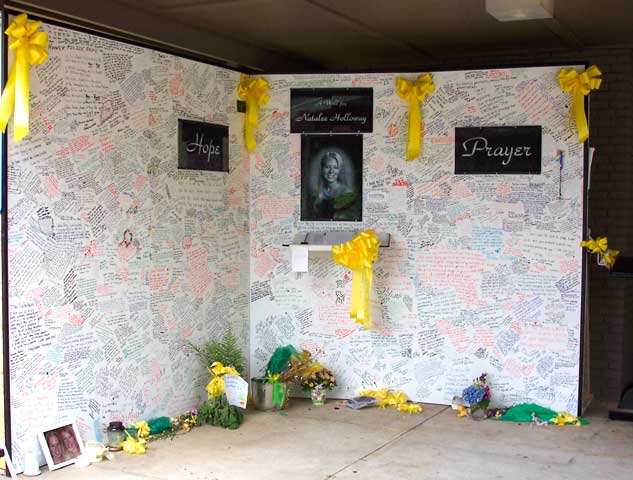
The town remembers—and residents describe a lasting impact
When WVTM 13 returned to Mountain Brook for the 18th anniversary of Natalee’s disappearance in May 2023, residents and local officials described a community that still remembered the days when yellow bows appeared throughout the area. City Council member Billy Pritchard recalled that his son had been one year behind Natalee. He said residents had tried to help find answers and that the case remained in people’s minds.
Another resident, attorney Tommy James, told the station that the tragedy brought back memories for families with children graduating from the same high school. His comments point to one reason the case continues to resonate locally: it is not only a story about a missing person, but also a story about a familiar school, a graduation season and the sudden vulnerability that can enter an ordinary family’s life.
WVTM also reported that the community’s response influenced how some school trips and student travel were handled. That is a meaningful detail, but it should not be exaggerated into a claim that one specific policy or rule was adopted citywide because of the case. The public reporting supports the broader observation that the tragedy remained part of local conversations about student travel and safety.

What the case changed—and what the record can actually show
It is tempting to describe the disappearance as the moment that changed every part of Mountain Brook. The available reporting supports a more measured conclusion. The case drew an extraordinary show of public solidarity, became a recurring subject of local remembrance, and remained present in conversations about young people travelling after graduation. Residents interviewed years later still recalled the ribbons and the effort to support Natalee’s family.
Those accounts are valuable, but they are not a complete survey of every resident or every institution. They do not establish that all people in Mountain Brook think about the case in the same way, or that every local policy changed because of it. A responsible account should leave room for different experiences: for those who knew Natalee, for classmates who remember the trip, for residents who joined the ribbon campaign, and for newer generations who know the story through its lasting place in local history.
Mountain Brook itself has a history that predates the case by decades. The Encyclopedia of Alabama traces the development of Mountain Brook Estates to the 1920s and notes that the city incorporated in 1942. It describes a municipality with its own schools, civic structure, commercial villages and public amenities. That wider context matters: the case is part of the town’s story, not the entirety of it.
Why the story still follows Mountain Brook
There are several reasons the case remains part of the town’s public memory. First, Natalee was a local graduate whose disappearance happened just after a major life milestone. Second, the community’s response was unusually visible: the yellow ribbons could be seen in public spaces and on private property. Third, the case continued to produce major developments, including van der Sloot’s 2023 guilty plea in the federal extortion and wire-fraud case, bringing renewed national attention to the family and the town.
That federal case must be described accurately. Van der Sloot pleaded guilty to extortion and wire fraud involving Beth Holloway; those charges were not a prosecution for Natalee’s disappearance or murder. The distinction is important because the public’s desire for answers and the legal outcomes in separate jurisdictions are not interchangeable. For a fuller account of the later developments, see our coverage of Beth Holloway reading her letter to Joran and the renewed debate about senior-trip safety.
Mountain Brook is more than the shadow of one case
The title of this article reflects the way the case still shadows the town’s public image. It does not mean that Mountain Brook has stopped being a community with its own daily life, or that Natalee’s memory can be reduced to a crime story. The ribbons, memorials and recollections reveal something more human: people trying to stand beside a family when they could not bring a loved one home.
Nearly two decades on, the most durable part of that response may be the simplest. Residents wanted Beth Holloway and her family to know they were not alone. The yellow bows gave that message a visible form, and the later use of ribbons for other causes suggests that the gesture outlasted the original headlines.
Mountain Brook will continue to be a city of schools, shops, parks, families and civic life. Natalee Holloway’s story will remain one part of its history, remembered not only for the unanswered questions and the years of national coverage, but also for the neighbors who chose to show up for one another.
Frequently asked questions
Was Natalee Holloway from Mountain Brook, Alabama?
Yes. Natalee Holloway graduated from Mountain Brook High School in May 2005 and lived in the Mountain Brook area before travelling to Aruba for a graduation trip.
Why did residents put yellow ribbons around Mountain Brook?
Residents displayed yellow ribbons on mailboxes, trees, homes and businesses as a visible sign of support for Natalee’s family and hope for her safe return after she disappeared in May 2005.
What role did Smith’s Variety play?
WVTM 13 reported that employees at Smith’s Variety in the Crestline area helped make hundreds or possibly thousands of yellow bows for residents to display. The store’s current owner later described the effort as an important part of the community’s memory.
Does the Natalee Holloway case define Mountain Brook today?
The case remains a significant part of the town’s public memory, but Mountain Brook has a broader identity and history. Local reporting documents lasting remembrance and community support; it does not show that every resident or institution is defined by the case.
Did the case change student-trip safety practices?
In 2023, WVTM 13 quoted a local city council member saying that protocols and approaches to trips like the one Natalee took had changed. The available reporting supports that general observation, but it does not identify one specific citywide rule or policy created because of the case.

Sources and further reading
- WVTM 13: Mountain Brook remembers yellow bows in memory of Natalee Holloway (May 11, 2023).
- WVTM 13: A small show of support—Smith’s Variety remembers yellow ribbons (October 19, 2023).
- WVTM 13: Mountain Brook remembers Natalee Holloway on the 18th anniversary (May 31, 2023).
- CBS News / Associated Press: Natalee Holloway—Paradise Lost (June 7, 2005).
- Encyclopedia of Alabama: Mountain Brook (updated October 15, 2025).
- Wikimedia Commons: Natalee Holloway memorial wall and news crews (photograph dated June 10, 2005; CC BY-SA 2.0).
Editorial note: This article focuses on the documented community response and local memory. It does not claim that every resident shares the same view or that the case is the sole defining feature of Mountain Brook.